
A year after a wildcat strike, New York’s state prisons still had 4,600 unfilled correctional officer positions and roughly 3,000 National Guard troops standing in for them. Shortage-related costs had already passed $1 billion.
New York is the loudest example, not the exception. In the federal system, officer vacancy rates have climbed from a traditional 10 to 12 percent to 22 to 25 percent, according to a Congressional Research Service report. State after state reports the same pattern: unfilled posts, mandatory overtime, and staff stretched across more ground than a roster can cover.
This is not a problem technology solves on its own. Hiring, pay, and working conditions are the real levers. But there is a specific slice of correctional work, the scheduled rounds and perimeter routes that have to happen whether the shift is full or not, where robotics is starting to earn a place. This piece looks at the shortage, where the gaps show up first, and what a robot can and cannot honestly take on.
The Numbers Behind the Shortage
The headline figures are stark, and they come from the agencies and auditors themselves.
- New York: The state’s corrections department accounted for $709 million in overtime in 2025, 44 percent of all state overtime spending, and 8.7 million overtime hours. Average overtime per employee nearly doubled, from 220 hours in 2020 to 432 in 2025.
- Federal Bureau of Prisons: Correctional officer staffing fell from about 19,000 to about 15,600 between 2016 and 2022, while overtime costs more than doubled to $275 million.
- Oklahoma: The Department of Corrections paid $35.6 million in overtime in 2025, about 48 percent of all overtime paid to state employees. A 2022 legislative report found facilities operating with 40 to 45 percent of the staff they needed.
- Nevada: Overtime reached $52 million in fiscal year 2026, leaving a $38 million budget shortfall. A staffing study recommended hiring 800 new officers.
The causes are consistent across reports: pay that doesn’t compete with other law enforcement, dangerous and stressful working conditions, shift work, and the mandatory overtime that the shortage itself creates.
Why Overtime Doesn’t Fix It
Overtime keeps posts filled in the short term. Over time, it feeds the problem it is covering.
Nevada’s corrections director described the cycle plainly. Short staffing raises the risk of violence. Injured people need hospital trips. Officers leave their posts to escort them, which creates more overtime and more strain on whoever is left.
The same pressure shows up in quieter ways. When the federal system runs short, it pulls non-custody staff, including teachers, case managers, and medical workers, into officer posts. The CRS report notes that this can cancel rehabilitative programming outright for the day. The post gets covered. The work that post was supposed to protect does not.
And officers working 400-plus overtime hours a year are the same officers deciding whether to stay. Burnout drives turnover, turnover drives overtime, and overtime drives burnout.
Where the Gaps Show Up First: Rounds and Perimeters
Not every post is equally exposed when a shift runs short. The work that slips first tends to be the work that is repetitive, scheduled, and hard to watch: overnight housing unit rounds, welfare checks, and fence line walks.
Those are also the tasks that regulators and investigators examine most closely when something goes wrong. In North Carolina, state reviews of deaths at the Mecklenburg County jail found missed safety checks, including eleven missed checks over a ten-hour window in one case, and the jail failed the state’s surveillance rule in every inspection over a two-year period. The sheriff disputed how the state counted the rounds, and the reviews did not tie the gaps to staffing. But the case shows what is at stake when rounds are inconsistent or hard to prove.
Rounds create two problems at once. They have to happen, and they have to be documented. A short roster makes both harder.
What Robotics Can Realistically Take On
A robot in a correctional facility is not an officer, and anyone selling it as one is overselling. What it can do is narrower and more useful than the headlines suggest.
Consistent route coverage. A robot walks a configured route on a set schedule, including the overnight rounds that are hardest to staff. It does not get pulled to an escort halfway through.
An accountable record. Every route produces a record of where the unit went and when, with audio and video. Coverage becomes something a facility can show rather than something it asserts.
Faster eyes on a problem. A robot on a route can surface signs of distress or a medical emergency to staff for review, so an officer can assess and respond sooner.
Perimeter and fence line coverage. Outdoor routes along fences and boundaries, recorded and reported the same way as interior rounds.
Monitoring for contraband and devices. Flagged to staff for follow-up, not acted on by the robot.
What it cannot do matters just as much:
- It does not make decisions about people. Officers assess and respond.
- It does not replace supervision or fill a post on its own.
- It does not work without network coverage on its routes.
- It does not physically intervene with anyone.
What Other Agencies Are Testing
A few agencies have moved past the idea stage.
In 2024, the Cobb County Sheriff’s Office in Georgia ran a 90-day pilot with three wheeled patrol robots at its adult detention center, covering perimeter patrols and selected housing areas with 360-degree cameras, night vision, heat detection, and two-way audio.
In 2026, the Singapore Prison Service announced PROTECT, an autonomous 510 kg robot that patrols predefined routes, streams live video to a control center, and can be sent to incident scenes. It also carries officer-activated deterrents, including an acoustic device and irritant spray, under set rules of engagement.
Those two examples show how wide the range is. One is a camera platform on wheels. The other is built to respond to incidents with force options. Most American facilities evaluating robotics today are looking for something in between: reliable route coverage and documentation, with every decision about a person left to staff.
Where CORAS Fits
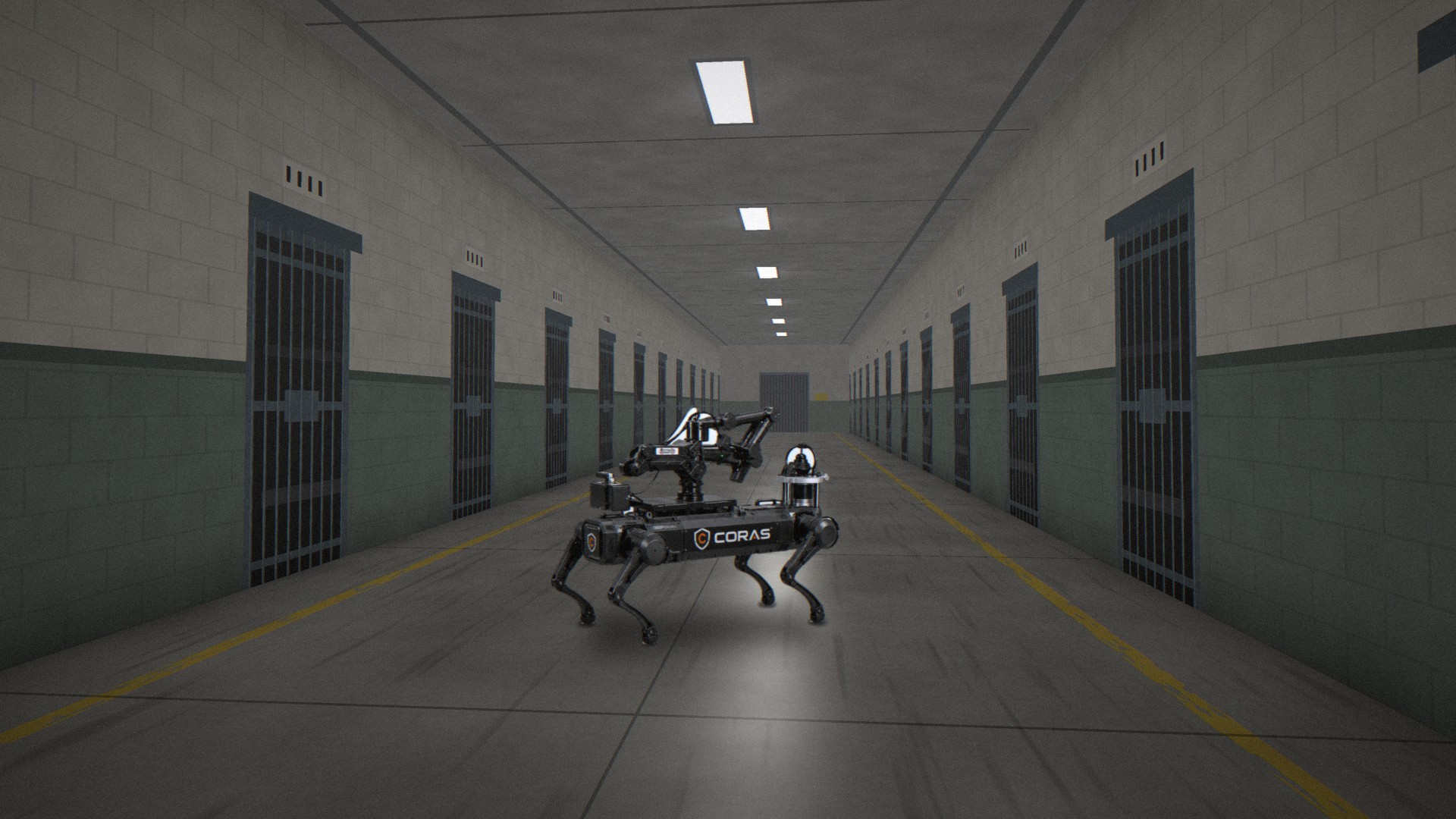
CORAS®, the Correction Officer Robotics Assistant System, is built for that middle ground.
It runs on a four-legged chassis rather than wheels, which is what lets it cross door thresholds, floor grates, drains, and the uneven ground along a fence line without a ramp or a modified route. That is the practical difference between covering a paved corridor and covering a whole facility. (For more on why legs matter, see Legs Over Wheels: Why Quadruped Robots Are Moving Into Schools, Plants, and Secure Facilities.)
CORAS is configured during scoping for the specific routes it will cover:
- Housing unit configuration: interior routes through units and corridors, with audio and video coverage on your schedule.
- Perimeter configuration: fence line and boundary routes with intrusion monitoring.
In both, it reports into the systems officers already use, so output lands where staff already look. Everything it observes goes to staff, who make the calls the same way they do now.
It is also not the right fit everywhere. It is not built to physically intervene with a person. It needs network coverage on its routes. Jurisdictions that restrict recording in housing units need to settle that question first. And routes built around stairwells need the stair specification confirmed before deployment.
The Cost Math: Offsetting Overtime, Not Replacing Officers
The honest way to think about the economics is not “robot versus officer.” A robot does not fill a post. The question is which hours it can take off the overtime ledger.
Start with the work, not the hardware:
- How many hours a week go to scheduled rounds and perimeter walks? Include overnight and weekend shifts, which are usually the most expensive to staff.
- How much of that time is currently covered on overtime or by augmented staff? That is the cost a robot can realistically offset.
- What else would those officer hours go to? Housing unit presence, escorts, programming, and the posts that need a person.
- What does documentation cost today? Time spent logging rounds, and the exposure when a log can’t be backed up.
On the other side of the ledger: the system, its sensors, integration, operator training, and support. CORAS is available to purchase or lease, and which fits usually depends on whether the funding is capital or operating. That is worth deciding early, because it changes the shape of the proposal.
If the math only works by assuming a robot replaces an officer, it doesn’t work. If it works by covering specific routes consistently and returning officer hours to the work that needs judgment, it is worth a closer look.
Questions to Settle Before a Pilot
Most of what decides whether a corrections robotics deployment works is settled before the hardware arrives:
- Routes and schedule. Which units, which perimeter, which checkpoints, how often.
- Network. Does every route have coverage, and what do your IT and security policies allow on the network?
- Recording rules. Are there restrictions on audio or video in housing units in your jurisdiction?
- Data. Where recordings go, who can see them, and how long they are kept.
- Access. Escort, badging, and scheduling for installation and service inside a secure perimeter.
- Staff. Which officers operate the system, how they are trained, and how they are brought into the process early.
- Procurement. Specification sheets, current FCC certification and Covered List documentation, a written data handling summary, and warranty terms.
Talk to Us About Your Facility
MOSO Robotics is a family owned, nationwide distributor, secondary developer, and integrator. We scope CORAS deployments around how a correctional facility actually runs, install in person, and train your officers before we leave.
Describe your units, routes, and conditions, and we will tell you what the system can cover and what it cannot. Start a sales inquiry or contact our team.
Frequently Asked Questions
Why is there a correctional officer staffing shortage? Reports consistently point to non-competitive pay, dangerous and stressful working conditions, shift work, and mandatory overtime. Once a shortage starts, overtime and burnout drive further turnover, which deepens it.
Can robots replace correctional officers? No. A robot can cover scheduled routes, record what it sees, and flag issues to staff. Officers still make every decision about a person and handle anything that requires judgment or intervention.
What can a robot do in a correctional facility? Cover housing unit and perimeter routes on a schedule, record audio and video, surface signs of distress or medical emergency for staff review, flag possible contraband and devices, and produce a timestamped record of coverage.
How do facilities pay for corrections robotics? Systems like CORAS are typically available to purchase or lease. Purchase usually comes from capital funds, and leasing from operating budgets. Tell the vendor which you are working with early, since it shapes the proposal.
