
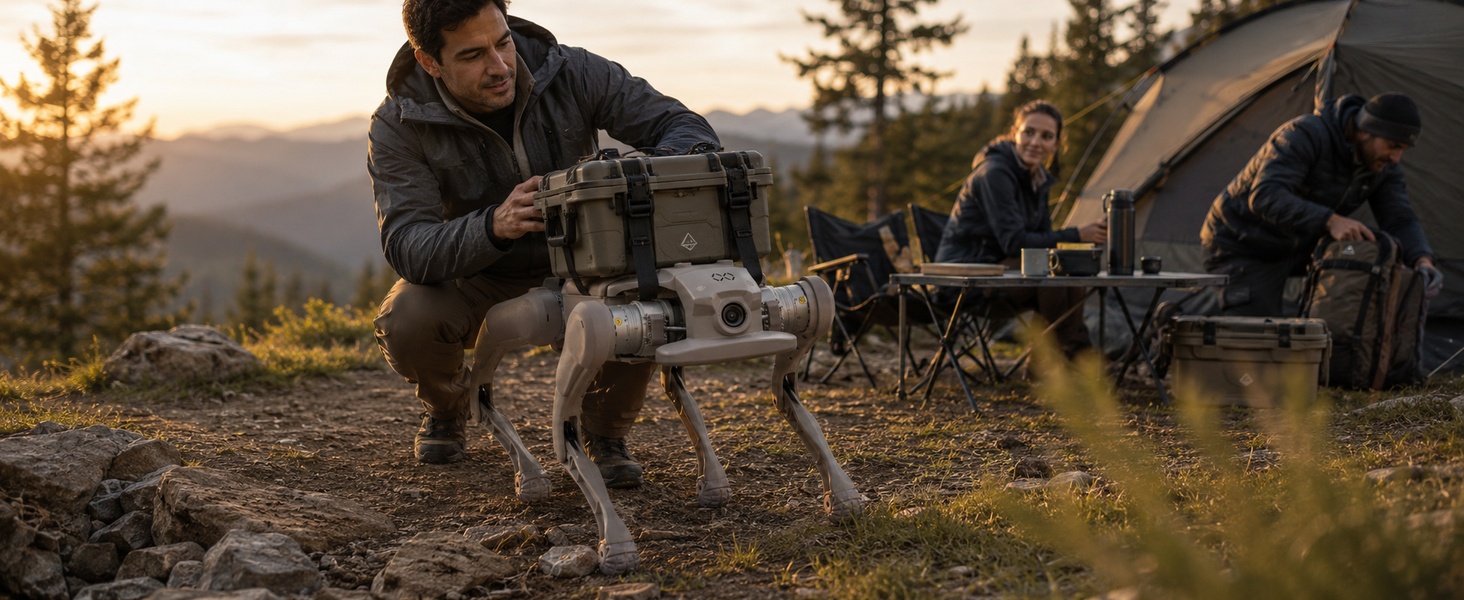
In the first half of 2026, manufacturers shipped close to 35,000 quadruped robots worldwide, according to Counterpoint Research. The largest share, 40 percent, went into industrial use. That is not a novelty market anymore. It is a tool category.
But “robot dog” still carries a lot of hype, and most of the coverage skips the question a buyer actually needs answered: what does a four-legged robot do that a wheeled one cannot, and is that difference worth paying for on your site?
The honest answer is that legs solve one specific problem very well and are overkill everywhere else. This piece walks through where quadruped robots are going in today, why legs matter in each of those places, and where they still fall short.
The One Thing Legs Do That Wheels Can’t
Wheels need a floor. Legs need a route.
A wheeled robot is fast, efficient, and cheap to run, as long as the ground stays flat and continuous. The moment the path includes a door threshold, a floor grate, a drain, a curb, gravel, a grassy slope, or a short run of stairs, a wheeled unit either needs a ramp, a modified route, or a person to carry it.
A quadruped steps over those things. That is the entire reason the form exists. Four legs give it a stable stance on uneven ground and let it place each foot where there is something to stand on, instead of needing a continuous surface underneath it.
That advantage comes at a cost, and it is worth being plain about it:
- Speed and runtime. Walking burns more energy than rolling. Most quadrupeds run one to two hours on a battery. A wheeled platform of similar size usually goes longer.
- Payload. Legs carry less than wheels. A quadruped moves a camera or a sensor package, not a pallet.
- Price. More motors, more joints, and more control software mean a higher sticker and higher upkeep.
So the first question is not “do we want a robot dog?” It is “does our route ever leave a flat floor?” If it doesn’t, buy wheels. If it does, legs start earning their cost.
Where Quadruped Robots Are Going In
Classrooms and University Labs
Education is one of the most practical homes for a quadruped, and not because students like watching them. A four-legged robot turns abstract engineering concepts into something that has to work in front of you. Balance, gait, sensor fusion, and control loops stop being diagrams when the robot has to stay upright while it walks across a lab floor.
Universities are building programs around exactly that. The University of Wisconsin–Eau Claire, for example, brought a commercial robot dog into its new assistive systems and robotics engineering major, where students work to get the robot to navigate spaces built for people.
What makes a quadruped useful in a classroom is development access, not top speed. A platform with an open SDK, Python support, and simulation lets students write code against the real hardware and test it virtually first.
That is the split in our own education lineup. The FX Navi is a compact 8 kg platform with an open low-level interface and a Python SDK, light enough to carry between rooms. The FX Aegis Edu steps up to a 15 kg chassis with an SDK, standardized APIs, Python development, and Isaac Sim support, for programs and university labs that will write their own software. Both come with curriculum and teacher training, because the hardware is the easy part of a robotics program.
Plant and Facility Inspection
Industrial sites are where legs make the clearest economic case. Plants, refineries, and utility yards are full of the exact obstacles that stop carts: grated walkways, stairs between levels, pipe runs, and outdoor ground that changes with the weather.
The work itself is repetitive. Walk a route, read gauges, take thermal images of equipment, flag anything out of range, and do it again tomorrow. That is a good fit for a robot carrying sensors, as long as it can get to every checkpoint.
One of the better-documented field tests came from the Oxford Robotics Institute, which ran legged robots through a live Chevron petrochemical facility in Belgium. The robots crossed concrete, gravel, and slopes, photographed analog and digital dials, captured thermal images of vents, and climbed industrial stairs. An autonomous inspection mission was repeated ten times. Eight ran to completion, and the other two were stopped by the operator during a cautious safety check.
That result is a useful reality check in both directions. It shows the approach works in a real hazardous facility. It also shows these are supervised tools, not set-and-forget machines.
For this kind of work, the platform matters less than what it carries and where it can operate. The FX Aegis Ultra is the model in our lineup built for it: an IP54-rated chassis for semi-outdoor and industrial settings, grades of 30 to 40 degrees, obstacle clearance to 35 cm, a 10 kg payload, and expansion ports for 3D radar, depth cameras, and RTK positioning.
Corrections and Secure Facilities
Correctional facilities face a problem that is getting harder, not easier: housing units and perimeters have to be covered on a schedule, around the clock, on a roster that is often short. Overnight rounds and fence line walks are some of the hardest posts to staff consistently.
Agencies have started testing robots for that coverage. In 2024, the Cobb County Sheriff’s Office in Georgia ran a 90-day pilot with three patrol robots at its adult detention center, covering perimeter patrols and monitoring of selected housing areas with 360-degree cameras, night vision, heat detection, and two-way audio.
Those robots were wheeled, which is a useful comparison point. A wheeled unit works well on paved interior corridors. A fence line, a drainage ditch, or the threshold into a housing unit is a different story. That is where a legged platform changes which routes can be covered at all.
What a robot can do on those routes is narrower and more practical than the headlines suggest. It walks a configured route, records audio and video, surfaces anything unusual to staff, and leaves a timestamped record of where it went. Officers still make every decision about a person.
That is how CORAS®, the Correction Officer Robotics Assistant System, is built: a legged platform configured for housing unit or perimeter routes, reporting into the systems officers already use. The value is not replacing officers. It is getting consistent coverage on the rounds that slip when a shift is short, and freeing officers for the calls that need a person.
Security and Route Coverage
Outside corrections, the same logic applies to campuses, industrial sites, and large properties. A security route often crosses parking lots, landscaping, loading docks, and outbuildings, a mix of surfaces that defeats most wheeled patrol units.
Today, most quadrupeds in this role are operated rather than fully autonomous. An operator runs the route, and the robot carries the camera and sensors that need to see it. That still has value: it puts eyes on areas a person would otherwise walk alone at night, and it records what it sees. But it is worth knowing going in, because it shapes staffing, training, and expectations.
Events and Public Demonstration
Not every deployment is operational. Open houses, recruiting events, trade shows, and public programs use quadrupeds because they draw a crowd. A unit with preloaded motions, like the FX Aegis Pro, can perform on day one without anyone writing code. For a school district, a police department’s recruiting table, or a brand activation, that is often the right tool for the job.
What a Quadruped Robot Can’t Do Yet
This is the section most vendors leave out, and it is the one that decides whether a deployment works.
Most units are operated, not autonomous. Autonomous navigation and patrol are on the roadmap for much of the market, including the Aegis series, where Faraday Future lists them as future over-the-air capabilities rather than features available at purchase. If a vendor tells you a robot will patrol on its own out of the box, ask to see it do that on your route.
Stair climbing and obstacle clearance are different specs. Obstacle clearance is the height of a single thing the robot can step over. Stair climb height is the riser height it can handle flight after flight. The Aegis Ultra clears obstacles up to 35 cm, but its continuous stair climb is 16 cm. Measure your stairs before you assume.
Runtime limits the route. One to two hours per battery is typical. A long perimeter or a full plant walk may need a second battery or a charging plan.
The sensors cost extra. On inspection and survey work, the radar, depth, thermal, and positioning modules can approach or exceed the price of the robot itself.
It does not replace supervision. A quadruped runs a defined task under your staff’s oversight. Anything that requires judgment, escalation, or a decision about a person still belongs to a person.
Is a Quadruped Right for Your Site? Four Questions
Before you evaluate any specific model, answer these:
- Does the route ever leave a flat floor? If not, a wheeled platform will likely serve you better for less.
- Are there stairs, and how tall are the risers? Compare them to the continuous stair climb spec, not the obstacle clearance.
- What does the robot need to carry? Add up every sensor and bracket, then check the payload rating.
- Who will run it? Today, that usually means a trained operator, so plan for staffing and training from the start.
If the answers point toward legs, the next step is matching the platform to the job. If they don’t, that is worth knowing before you spend the money.
Talk to Us About Your Route
MOSO Robotics is a family owned, nationwide distributor, secondary developer, and integrator for Faraday Future humanoid and quadruped robots. We handle the configuration, on-site installation, and operator training in house, and we will tell you plainly when a robot is not the right fit.
Describe the route and the task, and we will tell you what fits. Start a sales inquiry or contact our team.
Frequently Asked Questions
What are robot dogs used for? Quadruped robots are used for education and research, industrial inspection, security and route coverage, correctional facility rounds, and public demonstrations. Their main advantage is moving across stairs, thresholds, and uneven ground that stop wheeled robots.
Are quadruped robots better than wheeled robots? Only on routes that leave a flat floor. Wheeled robots are generally faster, run longer, carry more, and cost less. Quadrupeds earn their cost on grades, stairs, grates, and outdoor terrain.
Can quadruped robots work outdoors? Some can. Check the IP rating. An IP54-rated unit like the FX Aegis Ultra handles limited dust and splashing for semi-outdoor work, while an IP32 unit is meant for indoor use.
Do quadruped robots patrol on their own? Most do not yet. Many commercial quadrupeds are operated by a person today, with autonomous navigation and patrol listed as future capabilities. Ask any vendor whether autonomy ships at purchase or arrives in a later update.
